

Gary Dawson: We were based at the Stadium. The team were training on a field on an ex-rubbish dump the council had developed. It was a nice training field, but the gym wasn't particularly big and we didn't have space for the coaches. As we became more professional and sophisticated, we needed video analysis facilities, players' areas where they could go and relax.
Dave Rennie: I had been to Waikato Stadium a lot as a visiting coach, and it is a great stadium. You've got a nice coach's box, and the changing rooms are really good. There's a good warm-up room and the ground has a beautiful deck. It is a great place to play. But when chief executive Gary Dawson gave me a tour of the place it was terrible. Underneath the gym was in three parts. He'd open a door, which I thought was going to be a broom cupboard and the physios would be in there. Fozzy's office was in the corner of the players' lounge, a glass box. The other coaches were behind a big concrete wall with no windows. It was terrible. Gary was obviously very proud of the place but after we had finished the tour he said, 'What do you think?' I said, 'Have we got another option?'
Stu Williams (Chiefs manager): I had a couple of meetings with the Waikato Racing Club to check that out. The concept was great, we could have used the inside fields, but the facilities weren't quite right, and the money was an issue.
Dave Rennie: We were paying a lot of money to be housed at Waikato Stadium, but they were in a bit of financial trouble. They owed something like $600,000 from previous years. We were hunting everywhere for a place to develop. We looked at Te Rapa Racecourse and various other places.
Tom Coventry: My dad Dick, and my uncle Jim, were both groundsmen of the whole Ruakura complex. We had three options at the time. One was to stay at Waikato Stadium. The other was to build a purpose-built stadium out towards the Airport and another was to share a facility like St Peter's, the big college out at Cambridge. They were all loosely mentioned. We decided we would train at St Paul's Collegiate and were there for three months and did most of the pre-season before Christmas there. We were going to have to vacate when the new school year started, so I suggested we go to the University of Waikato, but they didn't have enough facilities to change in. I rang Dad and asked him if there was any chance we could use the facilities at Ruakura, especially their grass field. He said he would ask Mike Hosking, the overseer of the Ruakura complex who has since died. Dad said he had no problem. They played a little soccer and some social cricket on the field, but he couldn't see why the Chiefs couldn't use it. He said it got wet in winter, but I said it was largely a summer game now. I told Renns about it, and he told Gary Dawson. Gary walked across the field one day when Dad was mowing it and asked if the Chiefs could use it. At that time, Mike Hosking wandered across. Dad and Mike had a conversation with Gary, and they both said yes. We moved into the Meat Research Institute of New Zealand (MRINZ) building which had been an abattoir. It was derelict and full of old meat machinery and old X-ray and cutting machines that were now surplus. It was a massive big shed but vacant like a lot of the buildings there, as they were starting to decentralise everything. There was an office and while there was a front field, there was a sheep paddock alongside. Dad removed a trough that was in it, mowed it, filled some holes and we had a second field as well.
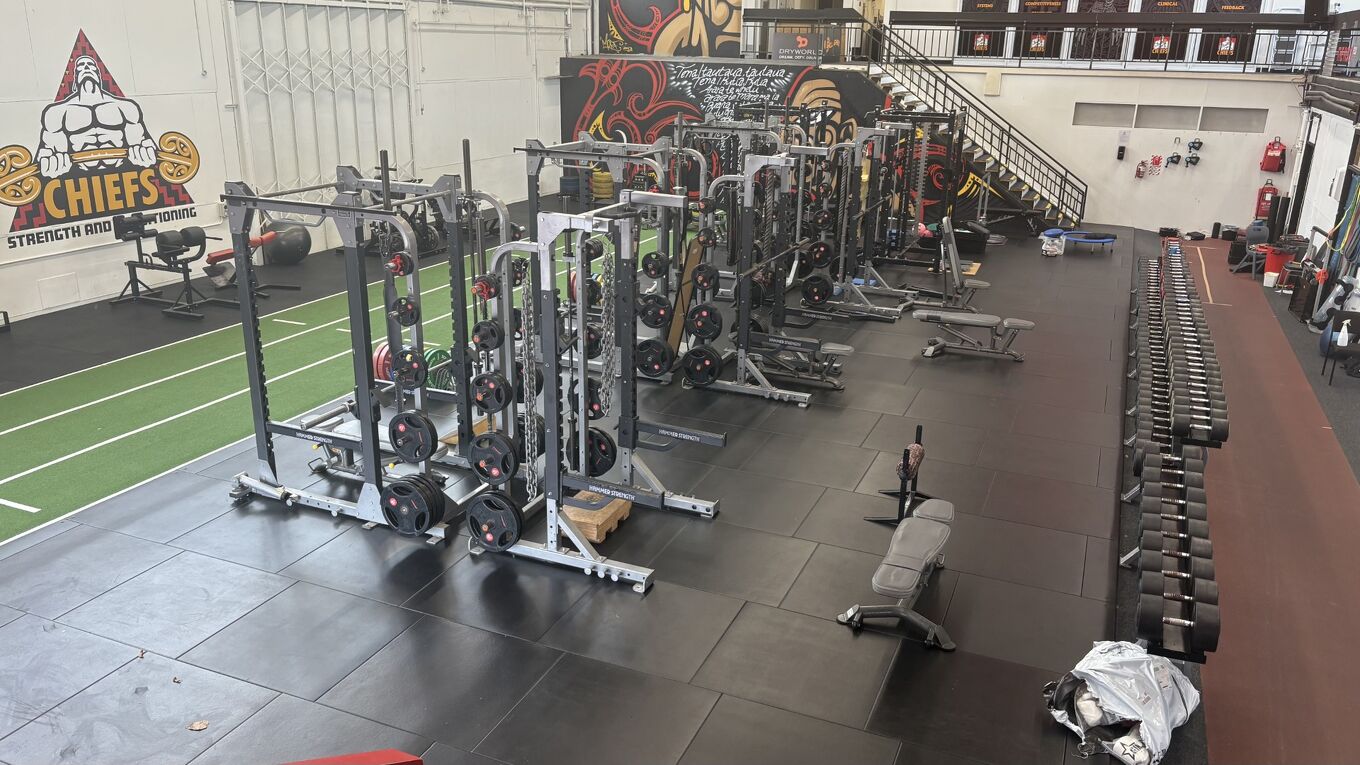
Dave Rennie: We went and had a look at Ruakura. It was pretty rustic, but perfect for what we wanted. Ruakura spent a lot of money doing the place up and putting some rooms in, moving things and knocking other things over. They put that onto the rent for the next four years, but even with all the extra they did, it was still cheaper than the rent we were paying at the stadium, and the office over the road. It had probably three times the space. It meant the whole business could be together. It wasn't flash which was something we liked. We did well. For the pre-season, we were based at St Paul's Collegiate, but we'd go down to Ruakura in groups and do a lot of work, knock over walls, sand and paint so that our boys got a bit of skin in the place.
Tom Coventry: We were walking around with Stu and Renns and we decided where our offices could be and where we could put our gym. Within two weeks, we had a working bee and we moved all the gear out. We took a lot of machinery to a metal recycling place. I remember Liam Messam grizzling about having to paint, but we spent about a week making it look like some sort of office. It was a pretty ugly battleship grey paint, but we slapped it on everything, put in some gym equipment and we were away. The offices were pretty old, but they were suitable. We used those and moved everything from Waikato Stadium into Ruakura. If Mike and Dad had said no when Gary Dawson walked out to them we would probably have been somewhere else.
Wayne Smith: As soon as we walked in Dave, with his great imagination, was looking around and saying we could have our gym here, a rehab area upstairs, that could be our coaches' area, another area for our staff; he was designing it all in his mind. We had no money, but we had a few tradesmen in the group. Kahui was a carpenter, Alex Bradley was a plumber. We had to borrow a bit of money, but essentially the players pulled the place down and put it back up. We gave them Wednesdays off to work on the building. We only lost one player, who stood on a nail, so we did pretty well. Stu Williams found a container that had been left by the farmers. He broke into it and found some desks and whiteboards, so we used them. He found some grey paint somewhere and we used that, some of the wives and girlfriends came in and helped with the painting. Some of the boys had no idea how to paint, especially with roller brushes - they were rolling over light switches. But on the 25 January we moved in.
Stu Williams: We had groups going down there to knock out walls with sledgehammers. The company doing the project put spray paint on the walls that had to come down, but I got down there one day just as a group of the players were about to go ballistic and knock down one of the outside structural walls. Someone had put spray paint on the wrong wall and they were about to knock down a load bearing wall, if they'd done that the whole front of the building could have come down.
Tom Coventry: The Ruakura people loved having us. It was a special time. We were right underneath the big office building and there were people peering out of windows who would come down and watch us train, especially in the sun during summertime. They got to know the players. We used the swimming pool which is beside the field and we eventually created a clubhouse which the Ruakura staff used on Friday nights to play a bit of bingo and have a drink. We ended up, on Renns' initiative, taking that over as a meeting place after every game. Wives and families could come back, there would be a band in the corner, there would be food put on and there were drinks. After every game, we'd get on the bus and return to Ruakura. It was a good time. It has died a bit of a death since Renns left. There were a couple of cafes we frequented at Ruakura, one of which had the old homemade pies, filled rolls and cups of tea. We'd go and mix with the staff. There was communication for the boys with ordinary people they probably wouldn't get in other places. Brodie used to zip over and sit in the tractor shed with Dad and Jim and talk about how to mow grass or prune a tree.
Lelia Masaga: At first, it felt like they'd bought a cowshed. We'd train in the morning, and then go and smash walls down in the afternoon. At the time, I thought it was the dumbest thing ever, but I look back now and think, 'We built that place.' We all bought bikes to get around on and trained at schools. I thought that was really cool, having all those young guys watching us who would one day want to take your place.
Tom Coventry: There was one funny story. Straws didn't want to go into the MRINZ building because there was a big radiation sign on the side of the building because there had been X-ray machines there to X-ray the meat. He was adamant they would have left radioactive residue. I said, 'Come on mate, it's been empty for years.' He said, 'That radiation hangs around for a while.' So we had to get somebody out to come and check, so we could all be comfortable that it was safe enough for us and we weren't going to grow another finger or head. And sure enough it was all fine.
Dave Rennie: There wasn't a proper training field at Ruakura and by May we had to stop training the because the field was knackered. But that wasn't a bad thing either because we started training at schools and the connection proved worthwhile. Initially, at Ruakura, anyone could come along and watch training. If you wanted to get Sonny Bill Williams' autograph or whatever, you could just go there as opposed to trying to get into Waikato Stadium.
Dallas Fisher: We moved to Ruakura and needed a training ground because you've got to train on the same surface you play on. We needed to turn the Oval at Ruakura into a sand carpet. So I rang my bankers and said I wanted to borrow $285,000. I rang Steve Tew, I'll never forget this conversation. We get on very well. I said, 'Steve, we're borrowing $285,000 from the BNZ to build a field.' He went ballistic. I said, 'Steve, if it was the chairman of the Canterbury Rugby Union ringing you about this, you would say yes, so we're doing it.' He asked how we were going to repay it? I said, 'I'm looking after that, don't you worry.' So we did. We borrowed the money, won the Championship and within three months repaid 100% of it. Amazing.
Tom Coventry: The Perry Group helped us out with upgrading the Oval. My brother Richard worked for them and Simon Perry, the head, decided to help us out. The field would get quite soggy when any rain got on it and we would rip it to pieces. The Perry Group came in and gave us sand from their quarry and put it down for us. That made a massive difference, we could be on the field just about all the time. As soon as we got off it, Dad would be on the field with his mower, to clip it and make sure it was fertilised and watered. They put the sprinklers on it and it was a picture. He took pride in making sure it was up to speed.
Dallas Fisher: Ruakura was fundamental to the Chiefs' success. The campus is owned by Tainui, and was the old Research Institute. We put some sweat equity into it when we removed walls and painted. The ownership of the facility by the player group was massive. I don't know how we financed it, but we just got things done. Bit by bit we added to the weights and gym areas, had the administration at the front, upstairs. It was our home.
Tom Coventry: It was wonderful in those years. Renns takes a lot of credit for how he built that, and the connection to not only the Ruakura community but the Waikato community.